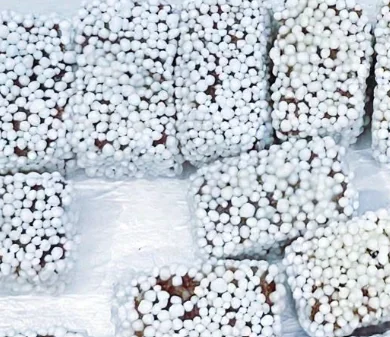
To the uninitiated traveler gazing into a glass confectionery display in the hill bazaars of Almora, Nainital, or Halduchaur, Bal Mithai presents an intriguing culinary mystery. Its dark, rich mahogany hue frequently prompts visitors from Mumbai, Delhi, or abroad to ask: "Is this a chocolate sweet?" But ask any seasoned mountain halwai whose hands bear the gentle burn marks of iron kadais, and they will smile. There is not a single particle of cocoa in Bal Mithai. What you are witnessing is one of the most sophisticated examples of slow-heat dairy caramelization in the global culinary canon.
1. Origins of a Hill Legend
The origins of Bal Mithai trace back over a century and a half to the historic royal capital of the Chand dynasty in Almora. Confectioners in the cobblestone alleyways of Lala Bazaar discovered that when evaporated milk solids (khoya) were roasted slowly over low embers of oak charcoal for several continuous hours, the lactose sugars underwent a complete metamorphosis.
Rather than burning, the concentrated milk solids formed a chewy, toffee-like confection with an exceptionally low moisture content. In an era long before electrical refrigeration, this extended the shelf life of the sweet to weeks, making it the supreme gift for travelers traversing the rugged mountain trails of Uttarakhand.
Today, while modern industrial shops attempt to imitate this confection using artificial cocoa powder, brown food dyes, and instant milk powder, Vatsalaa Restro & Sweets remains steadfastly committed to the pure, unhurried 6-hour roast that honors ancestral hill heritage.
2. Hour by Hour: Inside the Bal Mithai Bhatti
Making authentic Bal Mithai is an arduous physical craft that demands total sensory concentration. Here is how our artisan sweet masters transform raw mountain milk into signature Bal Mithai every day:
Hour 1–2: The Great Reduction
The process begins with fresh, unfiltered full-cream milk poured into massive concave iron cauldrons. The halwai maintains a steady, moderate flame, using a long wooden paddle (Danda) to keep the liquid in continuous circular motion. As steam billows into the morning air, water evaporates steadily, concentrating milk fats, proteins, and minerals until the liquid collapses into thick, creamy rabri.
Hour 3–4: The Mawa Transition & First Caramelization
The liquid completely transforms into soft white khoya. At this critical juncture, pure cane sugar is introduced. As the sugar dissolves into the hot mawa, the mixture liquefies slightly before tightening again. The heat must now be reduced to a delicate, gentle whisper. If the heat is too high, the milk proteins scorch, turning bitter; if too low, the moisture fails to evaporate cleanly. The halwai scrapes every square inch of the iron pan continually to ensure perfectly uniform heat distribution.
Hour 5–6: The Maillard Climax & Mahogany Fudge
Now begins the transformative stage known in halwai parlance as Kadhai ki Bhunai. Over the next two hours, the pale mawa slowly darkens: from cream to tan, from tan to rich hazelnut, and finally to a deep, lustrous mahogany brown.
During this prolonged roast, the Maillard reaction creates hundreds of new aromatic flavor compounds—notes of toasted almonds, roasted chicory, condensed caramel, and dark toffee. When the fudge pulls cleanly away from the iron surface without sticking to the spatula, the sweet master knows the moisture equilibrium is perfect.
The molten fudge is transferred onto greased stone cooling slabs, leveled with brass rollers to a precise thickness of one inch, and left to rest undisturbed for several hours until firm.
3. The Art of the Sugar Dana: The Crunchy Halo
What truly sets Bal Mithai apart visually and texturally from any other Indian confection is its signature coating of tiny white nonpareils, locally called Sugar Dana or Khas Khas Dana.
Crafting these miniature pearls is an ancient specialized craft in itself:
- Boiled cane sugar syrup is dripped into large, heated hemispherical copper pans suspended by ropes from the ceiling.
- The artisan oscillates the swinging pan rhythmically with one hand while tossing poppy seeds or tiny sugar nuclei with the other.
- Layer upon microscopic layer of hot sugar crystallizes around each tiny core until uniform, snow-white crunchy globules are formed.
Once the cooled mahogany khoya fudge is sliced into neat rectangular bite-sized bars, each block is brushed with a delicate touch of warm sugar glaze and rolled by hand through shallow trays of fresh sugar dana. The white beads adhere firmly to the exterior, creating that iconic visual contrast of pristine white pearls surrounding dark, rich fudge.
4. Flavor Architecture: The Master Tasting Profile
When you take a bite of fresh Vatsalaa Bal Mithai, your palate experiences a deliberate textural and flavor progression:
- The Attack (First 3 Seconds): The immediate sensation is the crisp, satisfying crunch of the sugar globules breaking beneath your teeth, delivering a clean, refreshing burst of light sweetness.
- The Body (4 to 10 Seconds): The dense, velvety fudge yields gently. Melted by mouth temperature, rich dairy fats coat the tongue, releasing complex roasted notes of caramelized lactose and pure mountain milk.
- The Finish (Post 10 Seconds): Unlike cheap sweets laden with artificial syrups, authentic Bal Mithai leaves a clean, lingering aftertaste of toasted dairy without sticky throat irritation.
5. Bal Mithai vs Chocolate Mithai: Which Should You Choose?
Visitors often ask about the difference between Bal Mithai and its sibling confection, Kumaoni Chocolate Mithai. Both share the exact same 6-hour roasted mahogany khoya fudge base. The sole difference is that Chocolate Mithai is served plain with clean, unadorned edges, omitting the sugar beads entirely.
If you love contrasting textures and the authentic nostalgic festival experience, Bal Mithai is unbeatable. If you prefer subtle, less-sweet dairy richness that highlights pure roasted fudge alongside morning tea, Chocolate Mithai is the connoisseur's choice. Read our full comparison on our Chocolate Mithai page.
6. Bringing the Pride of Kumaon to Your Family
At Vatsalaa Restro & Sweets, Bal Mithai is not merely a product in our inventory; it is our heritage, our identity, and our deepest commitment to culinary authenticity. Every batch we craft in Halduchaur carries over twenty years of passion and hundreds of years of mountain food history.
Stop by our Halduchaur flagship store on your way through the foothills, order fresh travel boxes for your journey, or arrange bulk celebratory boxes for wedding bhaji and family milestones through our bulk sweet ordering desk.