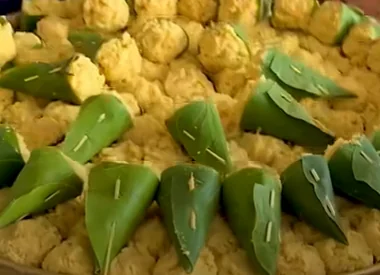
Nature's Most Elegant Confectionery Wrapper
Among the rich repertoire of Indian sweets, packaging is almost universally utilitarian—paper liners, silver leaf, or cardboard boxes. In the Kumaon hills, however, ancient confectioners developed an edible packaging marvel that predates modern packaging by centuries: Singodi (also spelled Singori).
Shaped into neat green cones, Singodi is an unforgettable sight in mountain halwai shops. Each cone contains sweet, cardamom-infused condensed milk solids wrapped inside a freshly harvested leaf of the wild Malu tree (Bauhinia vahlii).
The Malu Leaf Botanical Connection
The Malu climber grows abundantly across the sub-Himalayan valleys and temperate forests of Uttarakhand. Its broad, pliable leaves possess a clean, distinct botanical fragrance. When warm, freshly prepared mawa is folded into the freshly cleaned leaf, the gentle heat extracts essential oils from the leaf, permeating the outer layer of the sweet with a subtle, earthy mountain aroma.
How Singodi Is Prepared
- Khoya Reduction: Fresh cow's milk is simmered until reduced to soft, pliable khoya. Unlike Bal Mithai, the khoya for Singodi is not caramelized into darkness; it retains a delicate golden-ivory tint.
- Flavoring: Pure cane sugar and freshly ground green cardamom seeds are incorporated into the warm dough.
- The Cone Fold: Skilled halwais form a leaf cone, fill it with the warm cardamom khoya, and tuck the top flap securely. As it cools, the sweet sets firmly into the cone shape.
How to Enjoy Singodi
When served, gently unwrap the malu leaf to reveal the soft, fragrant sweet within. While the leaf itself is not consumed, its aromatic oils impart a refreshing herbal essence that cuts through the rich richness of the dairy.
Because Singodi retains higher moisture than Bal Mithai, it is best enjoyed fresh within 3 to 5 days. At Vatsalaa Restro & Sweets in Halduchaur, Singodi is crafted daily in small, artisanal batches to ensure prime freshness.